

Your Waitress is a Philosopher
On the nature of customer service


The waitress is a central, colloquial figure not just in American life, but human life for the better part of almost 250 years. Yet, particularly in America, she has become this underappreciated asset in daily living and economic exchange. Like her brothers and sisters in agriculture, hospitality, and other roles oriented towards the service of community, the waitress has become stuck in an idea of herself, bound to its rules and restrictions. Her value, her character, as a real human person, come second to her ability to sell herself, and the establishment she represents, to us as their greedy, hungry patrons. Something about the nature of the waitress, the appeal of this job to so many women and men in college, people short on cash, or those without a proper retirement speaks to this horrid underbelly of the American experience, and reflects the larger nature of customer service as an industry which attempts to explain away this underbelly through the fulfillment of needs.
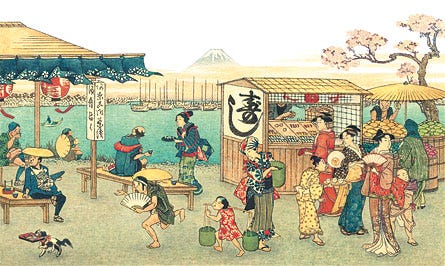
The waitress does not enter her profession with starry-eyed dreams of a career, or long-term ambitions to stay and master her craft. Unless, of course, there is some corporate latter she can climb from her position into management, the waitress enters her position out of necessity. She is the prime capitalist, rather the prime capitalist’s prime laborer. She becomes the waitress as we understand her out of a need to make her ends meet, to supplement an income, or simply for a quick turnaround on cash. This is the first sin of modern customer service. There was, once, a craft to foodservice. As far back as the 12th century in China, eating out was becoming more than street food, it was becoming a communal and performative experience, in which waiters sang, or 16th century Japan when seasonal menus were designed to tell stories.

“Oh! I see. And I’ve sort of been maintaining my amateur status so that I can waitress in the Olympics.” - Rachel Green (Played by Jennifer Anniston), ‘Friends’
To be clear, the artistry of food has not been totally lost on us. It has been merely moved further and further into the back of the house, and higher and higher up into the reach of only those wealthy enough to afford it. What’s left in reach of the median income is either the most obscure of dining locations, hidden gems in deserts of corporatized standardization, or bland, soulless drivel meant to satiate an appetite and nothing more. Modern restaurants, modern American restaurants, have become environments alone, charging double or triple what it costs to produce their food on the basis that the highly decorated restaurant interior is what the customer is here, and ultimately paying for. The chain restaurant also feeds into this cultural deterioration as corporate entities and their shareholders continue to prioritize bottom lines and expanding profit margins at the expense of paying their laborers fair wages or truly innovating a fairer, more creative dining environment for guests and staff alike.
The conditions this creates for the waitress, entering her new role likely out of desperation or with nothing else meaningful to turn to, could be the field day of any well trained Marxist. Her world becomes the grind, and the grind becomes a charade. One might argue the nature of customer service is quite innocent, rooted in the restaurant’s history, even. Staff put on performances for their patrons, selling a good time and good food to their guests. And yet, it inexplicably isn’t. As if it ever was, waiting tables is far from a stable, livable income in our economy — it is one of many side hustles busy people do alongside their main source of income, some one third of Americans in 2024, eating away at time with families and friends, time for the self, and time that could otherwise be spent perfecting their primary job because it does not seem perfectable. It’s just there to pay for living, and it can’t even do that correctly.
Thus, the performance art of the waitress is far more of a performance than it is even remotely an art. After she toils under her main job, or classes, or time taking care of her family, she must engage with us. All tired as well, not to mention hungry, we demand from her a personalized attention to our needs. It is not good enough that she merely brings us the food and drink, but that she becomes our best friend and our caretaker. Insultingly, she ceases to become herself in her rawest and most genuine form because she is supposed to keep up the appearances of her establishment.
By definition, that representation must be false. Marx’s alienation is uniquely manifested for the waitress by virtue of the social nature of her role. She is literally required, as a responsibility of her role, to put on the attitude the establishment is attempting to sell to customers. She must take her fears, her anxieties, her hopes, her goals, her thoughts, she must take herself and annihilate it. In a best case scenario, the seasoned waitress can learn how to incorporate those two worlds, use one to make the other. But this waitress is seasoned for a reason: she’s not exactly doing anything else. In many cases, her goals are dead, her hopes are for tomorrow alone. She does not dream far into the future. She reaches to see another day, to eat her next meal, and to provide for whoever she may need to provide for.
More insultingly, she must coddle her guests in order to prove her worth of their tips. They must always be right, they must always receive their way, and they must never, never feel upset. And this problem only gets worse the higher-up the ladder the waitress goes in the food service industry.
The further historical development of foodservice has emboldened a deteriorated customer base for the waitress to deal with. The western world saw restaurants come in droves from the kitchens of royalty and nobility after their deposition. In a truly egalitarian turn, those servants and chefs shared their work and their service with the people, their common man, rather than reserve their talents and care for the uber wealthy. And yet, as time has gone along, this nature has become a twisted malady for some who have come to internalize the hierarchical status they hold over the waitress. Especially as her patrons become richer, their attitudes become more infantile. They demand precisely that which they cannot have, with a foregone expectation of respect they do not inherently deserve, all while giving no amount of care or concern back to her. It appears, to these customers, that because of the nature of service as an industry, they have earned the right to be an asshole.
The material division of available restaurants to the larger public has also further divided larger society and the foodservice industry between the uber-wealthy and the poor. The ability to pay for an expensive meal, having access to exclusive skyscraper restaurants such as 10 Cubed in Manhattan, has become a status symbol for the wealthy while the poor fight over chains such as Olive Garden, and only reserve these dinners for birthdays or celebrations, if they can afford them.
This hurts the industry, as the exclusivity of a chef’s food or a restaurant's exemplar service becomes nothing more than the urban legends whispered by the rich to their near friends, behaving as nothing more than an unattainable dream for the rest of the world. This hurts consumers as they become divided by not just where they can afford to eat, but where they choose to. In either case, social distinctions about the nature of foodservice become rigid ceilings on the capacity for the industry, its professionals or its customers to engage with or grow from particular tastes and ideas.
The toil of the waitress has become symbolic of this rigid ability and the class divisions present in foodservice today. But what, then, of her (and thus, all of food’s) future?

Food is meant to feed people. Controversial take, I know. More than that, food holds deep symbolic meaning to us as creatures of such advanced consciousness. We perceive it as a representative for certain cultures, periods of time and regions of the world. Like us, it travels, and grows, and dies, and changes and becomes something more than it ever was. Moreover, different restaurants with different themes and different backgrounds imbue that core value, to feed the hungry, with an attempt to sell you their cultures, their stories, and themselves to us through the preparation and presentation of our meals. The venture capitalist restaurant developed in recent history has deteriorated this central purpose to a side thought -- second to driving up profits, selling themes and ideas and “innovating” their products through obscure, often damning creations no chef could truly be proud of.
And people, above all, must have patience and grace for the waitress. She is you. And you are her. She woke up late this morning, learned her father died and failed an exam this week. She’s studying law, biochemistry, or politics. She’s going to be your elected representative. Your waitress is a philosopher. And while, in the moment, she seems to be fucking up your order, or being “rude,” she’s actually the mother of a school of thought that will change the way you understand your world, and you owe her at the least a modicum of respect. Especially if you expect any from her. She is human. Her work is human work, social work. For us to deny her the space she deserves, the wages which can keep her afloat, and the freedom to adjust her life to her needs, not ours, is a condemnation of our ability not just to care for her, but to care for ourselves.